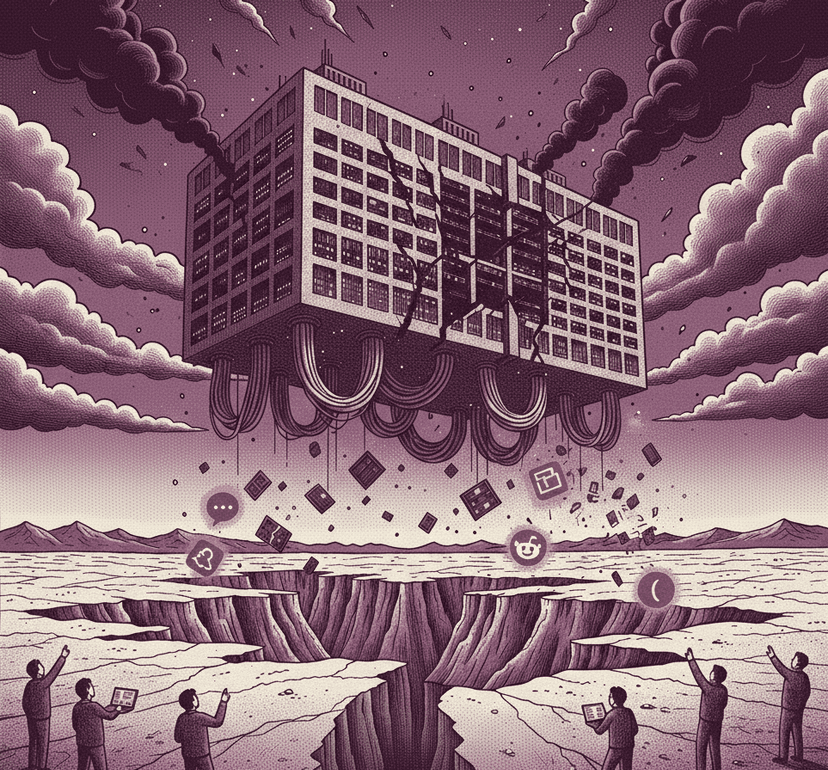
It started like any other Monday: coffee, Slack pings, a quick deploy. Then the graphs went weird.
You know that look — latency spikes that make no sense, alerts stacking on top of each other like falling dominoes. Someone on the team joked, “US-East-1’s haunted again,” and everyone laughed. Because that’s what you do when you’re scared something might actually be wrong.
Five minutes later, it was.
DynamoDB was failing. Lambda was stalling. EC2 was rolling dice. Reddit was down. So was Snapchat. So was Ring. And Alexa had gone eerily silent, which somehow made it all worse.
When AWS sneezed, the internet caught a cold.
The Day the Cloud Came Back to Earth
Amazon’s postmortem would later reveal the cause: a race condition in their internal DNS automation system.
Two processes tried to update the same configuration. One lagged. The other thought it was cleaning up old data and, in doing so, wiped out live IP addresses. Within seconds, a core part of AWS forgot where its own services lived.
That’s it. That’s all it took. A small, invisible slip — and a huge chunk of the modern web blinked offline.
The outage rippled outward, hitting banking apps, IoT devices, and global retail systems. CyberCube, an insurance analytics firm, estimated the insured losses between $38 million and $581 million. A half-billion-dollar bug, courtesy of the most sophisticated cloud platform on earth.
Our Beautiful, Fragile Internet
I’ve always loved the metaphor of “the cloud.” It feels limitless. Weightless. Safe.
But outages like this remind us it’s not a cloud — it’s a data center in Virginia. With racks, cables, human engineers, and scripts that sometimes collide. The cloud isn’t floating; it’s very much on the ground.
We tell ourselves the web is distributed, but it’s not. It’s concentrated in a few massive providers — AWS, Azure, Google Cloud — each one a single point of failure wearing a high-availability badge.
And that’s fine, until it isn’t.
The Developer’s Reality Check
Every developer I know did the same thing that morning: Checked status.aws.amazon.com. Refreshed Twitter (sorry, X). Then opened architecture diagrams in mild panic.
Multi-AZ suddenly didn’t feel like much of a safety net. Because if the problem’s DNS-level, availability zones don’t matter — they’re all connected through the same vulnerable systems.
You start thinking about multi-region setups. Or cross-cloud deployments. You even Google “GCP free tier.” But by the time you get to pricing, AWS is back up, and the sense of urgency quietly fades.
Until the next time.
What Broke, and What Broke Us
AWS fixed the race condition, rebuilt automation safeguards, and promised better internal isolation. They always do, and they always mean it.
But for everyone else, the bigger story isn’t how AWS failed — it’s how much we did.
Whole startups went offline. Entire workflows froze. For many companies, the outage revealed how few contingencies actually existed beyond “hope Amazon figures it out soon.”
We’ve spent years building on someone else’s resilience. It’s worked brilliantly — until it doesn’t.
Decentralization, or Just Diversification?
Whenever a big outage happens, people start whispering about decentralization. Web3. Distributed compute. Peer-to-peer redundancy.
It’s a compelling vision — no single company with the power to knock half the internet offline. But decentralization comes with trade-offs: governance, latency, cost, complexity. It’s not a silver bullet.
Maybe the answer isn’t pure decentralization — maybe it’s diversification. A mindset that says no provider, no region, no system should hold all the keys.
True resilience doesn’t mean avoiding failure. It means expecting it — and designing your system so failure doesn’t take you with it.
The Morning After the Outage
When services started coming back online, I refreshed our dashboards. Everything looked fine again. The graphs leveled out. Customers returned.
But I couldn’t shake the thought that we’d just survived on luck and other people’s engineering.
We talk about “trusting the cloud” as if trust is a feature you can deploy. But it’s not. Trust without redundancy is just faith. And faith doesn’t scale.
The next time I spin up a project, I’ll probably still click “us-east-1.” Out of habit. Out of convenience. But I’ll do it with a little more humility — and maybe a quiet plan B.
Because the cloud isn’t a metaphor. It’s a system built by humans, run by humans, and occasionally, broken by humans.
And when it sneezes, we all feel it.










 Ollie Darby